Office Driveway Cleaning: Recycling and Sustainability Commitment
 Office driveway cleaning can be a catalyst for broader sustainability on commercial premises. Our approach to cleaning drives and forecourts is integrated with an eco-friendly waste disposal area and a dedicated sustainable rubbish gardening area, delivering tidy entrances while reducing environmental impact. From driveway cleaning for offices to ongoing site stewardship, we prioritise materials recovery, on-site composting and local reuse networks so the entire property benefits.
Recycling percentage target: we aim for a 75% recycling rate across all office driveway cleaning waste streams within 24 months, with a stretch target of 85% by 2028. This recycling goal covers swept materials, vegetation cuttings, collected litter, and removed rubble from small repairs. The target is monitored monthly and reported in sustainability summaries to demonstrate progress and continuous improvement.
 The waste separation model aligns with many boroughs' approach to waste separation: clear segregations for organic green waste, dry recyclables such as mixed paper, cardboard and plastic, glass, and residual waste. On-site bins and signage encourage correct sorting during driveway maintenance and events. Key recycling activities include:
- Segregated collection of green waste for composting or local anaerobic digestion.
- Dedicated bins for dry recyclables captured during sweeping and clearing.
- Collection of bulky and reusable items for referral to community partners.
Local Transfer Stations and Material Flow
We coordinate with local transfer stations and municipal recycling centres to ensure materials collected from commercial entrances have clear onward routes. Where borough schemes allow, broken paving, loose aggregates and inert materials are delivered to nearby transfer hubs for recovery or recycling. Delivery to local transfer stations reduces haulage distances and ensures materials enter appropriate recycling streams rather than landfill.
Our logistics plan minimizes vehicle miles and pairs collection schedules with transfer station opening times. This reduces idling and waiting at municipal sites and supports the low-carbon operation of our fleet. Partnerships with borough-run transfer stations are formalised through scheduled drop-offs and shared planning for seasonal peaks in green waste and street cleansing residues.
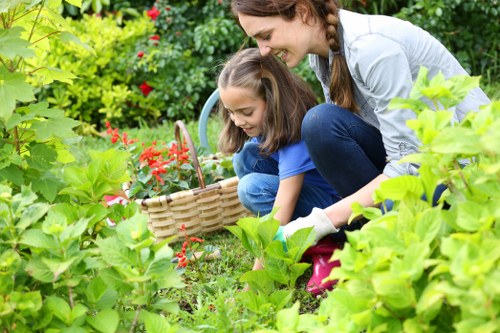 A practical on-site measure is the sustainable rubbish gardening area: a compact, shaded zone for segregated green waste, soil-friendly storage of wood chips and compost bays designed to accept trimmings from driveway edges and planted verges. This space is managed to avoid runoff and to encourage reuse of organic outputs in planters and boundary beds, supporting biodiversity while keeping driveways neat.
Partnerships with Charities and Reuse Networks
We have active partnerships with local charities and community reuse organisations to redirect items recovered during commercial driveway clearance. Functional furniture, reclaimed paving stones, planters and unused building materials are vetted and offered to charities for reuse or community projects. These relationships help divert items from landfill and create social value from routine cleaning activities.
When suitable, electronic devices found on-site (e.g., abandoned security lighting or chargers) are safely checked and referred to formal e-waste schemes run by partner organisations. This model of responsible diversion reinforces the circular economy embedded in our commercial driveway cleaning services and supports borough initiatives for extended producer responsibility.
A short checklist used on every site visit ensures consistent practice:
- Document volumes and types of materials collected.
- Sort into compostable, recyclable, reusable and residual streams.
- Coordinate drop-offs with local transfer stations or charity partners.
![A gardener wearing light-colored gloves is planting a vibrant purple and yellow primrose flower into dark, moist soil within a landscaped garden area. The garden features a neatly maintained lawn with dense, green grass in the foreground, bordered by flower beds with various plants and shrubs. In the background, there are taller bushes and a mature tree, indicating a well-established outdoor space. The scene is illuminated by natural daylight, suggesting a clear weather condition suitable for outdoor gardening activities. The presence of gardening tools, such as a small trowel partially visible at the bottom left, highlights the maintenance work involved. This setting showcases a tidy, thoughtfully designed garden that benefits from regular planting and landscaping, aligning with services like lawn care, planting, and outdoor space management offered by companies such as Office driveway cleaning in the [POSTCODE] area near [TOWN].](/pub/_photos/gardening/f1400256296.jpg) Low-carbon vans and fleet management are central to reducing the carbon footprint of office driveway cleaning operations. Our fleet includes hybrid and electric vans for short urban runs and low-emission Euro 6 vehicles where electric range is limited. Route optimisation software reduces unnecessary mileage and concentrates pickups to maximise load factors, cutting CO2 emissions per job.
Low-carbon vans and fleet management are central to reducing the carbon footprint of office driveway cleaning operations. Our fleet includes hybrid and electric vans for short urban runs and low-emission Euro 6 vehicles where electric range is limited. Route optimisation software reduces unnecessary mileage and concentrates pickups to maximise load factors, cutting CO2 emissions per job.
Vehicle charging and refuelling strategies prioritise off-peak, renewable electricity where available. In addition, driver training emphasises eco-driving techniques — gentle acceleration, anticipatory braking and speed management — reducing fuel use and particulate emissions on sensitive commercial and residential routes.
![A gardener and a young child are working together in a well-maintained garden. The adult, wearing a light blue shirt, jeans, and a straw hat, is kneeling on the grass, using a small trowel to plant or tend to a flower bed. The child, dressed in a bright green t-shirt and blue jeans, is assisting by holding a small potted plant with yellow flowers, positioned near a mature tree with dark bark. Surrounding them are lush green plants, including broad-leaved foliage, and a neatly trimmed lawn with dense, vibrant grass. To their left, a silver watering can and gardening tools are placed on the grass, indicating ongoing outdoor maintenance. The garden appears to be bordered by various shrubs and leafy plants, creating a lush, natural environment. The scene is lit by natural daylight, suggesting a clear, pleasant weather day, reflecting typical gardening activities associated with outdoor maintenance services such as lawn care and planting. This outdoor space exemplifies well-kept, family-friendly landscaping that a professional gardening service like Office driveway cleaning could help maintain, especially in the [POSTCODE]/[TOWN] area.](/pub/_photos/gardening/f1369374720.jpg) Measuring success involves both qualitative and quantitative indicators: tonnes diverted from landfill, percentage recycling achieved, number of charity referrals and reductions in fleet CO2. These metrics feed into quarterly sustainability reviews and are used to refine processes in response to local borough policies and changing waste separation rules.
Measuring success involves both qualitative and quantitative indicators: tonnes diverted from landfill, percentage recycling achieved, number of charity referrals and reductions in fleet CO2. These metrics feed into quarterly sustainability reviews and are used to refine processes in response to local borough policies and changing waste separation rules.
Conclusion: office driveway cleaning need not produce a linear waste trail. By combining clear recycling percentage targets, collaboration with local transfer stations, partnerships with charities for reuse, an organised sustainable rubbish gardening area, and a low-carbon vehicle strategy, commercial driveway cleaning becomes a visible part of a greener urban landscape. Our multi-faceted approach aligns with boroughs' waste separation frameworks and makes every sweep count toward a circular, resilient future.